
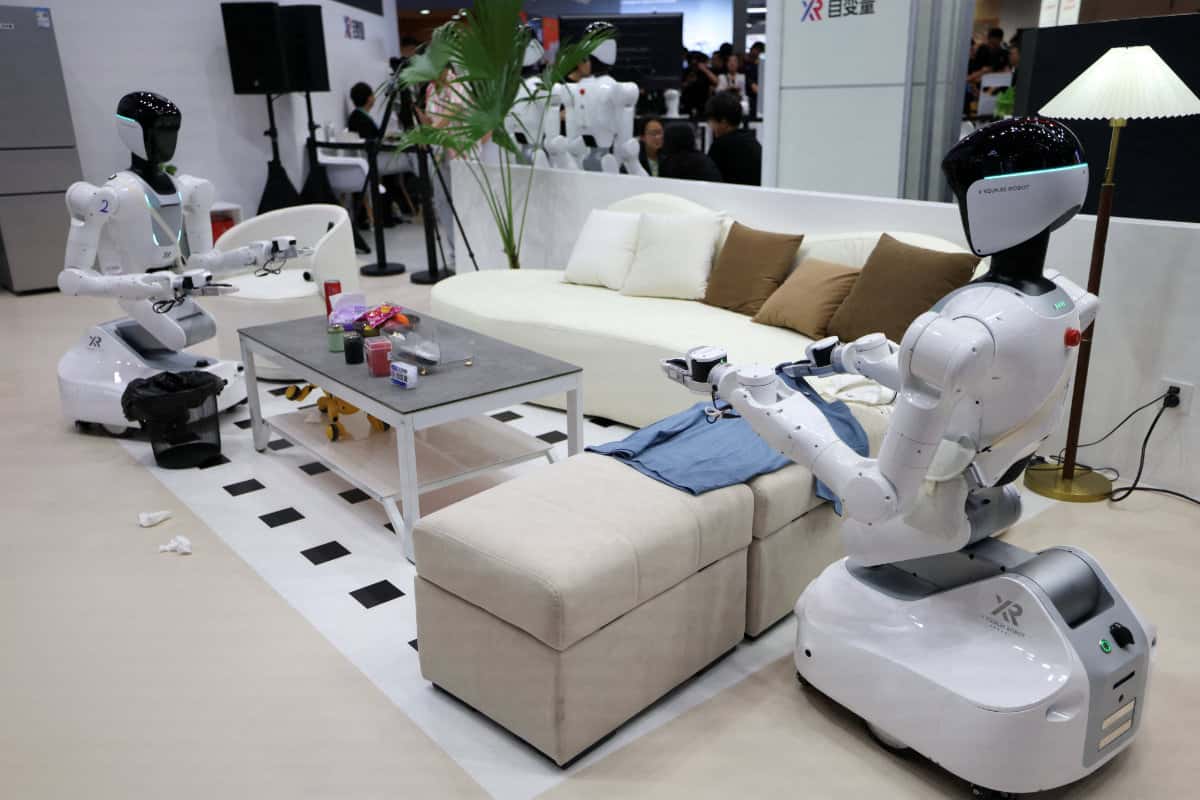
After years of developing humanoid robots that run, jump, perform sausages, and make complex movements, the Chinese robotics industry is entering a new stage – the creation of robots that not only move but also understand, learn, and make decisions.
According to a report ReutersChinese companies are shifting attention from developing the physical part of robots towards artificial intelligence that will enable them to perform various tasks without having to program separately for each one.

This field is known as Emboded Al, or artificial intelligence embedded, is considered one of the most promising ways of technological development.
Interest in this technology is growing rapidly. According to data from the ITjuzi research company, Chinese incarnated intelligence companies have provided 93.5 billion yen, about $13 billion, through $32 investment agreements during the first half of 2026 alone. This sum is five times higher compared to the same period in the preceding year.
Investments are increasingly being directed towards companies that develop intelligent systems of robots, as competition in physical equipment production is lowering prices and reducing the space for profit only from the sale of robots.
Developing this industry is opening a new front for technological competition between China and the United States. In the United States, companies such as Physical Intelligence, Skild Al and Generalist are working on systems that enable robots to learn different skills and to use them in new situations. Meanwhile, in China, companies like X Square, Galaxea and Spirit AI are developing models aimed at combining visual perception, understanding instructions and physical action.
The US has priority in several areas of advanced artificial intelligence research and access to powerful processors, while China relies on its large production capacities and direct co-operation with industrial factories.
One of the biggest challenges is robot training. Unlike the chatbots, which learn mainly from large amounts of text, robots need to understand physical interactions with the real world. They must learn how to capture objects, use tools, manipulate different materials, and adapt to changes in the environment.
To that end, companies are using videos of human activities, sensors based on the body of workers and computer simulations. An interesting example described by Reuters shows a robot who failed to put a pair of headphones in a closet that was out of his reach. After being shown videos of people who chose similar problems, the robot tried another way: He pushed a box near the closet and tried to climb over it to reach the object.
This experiment illustrates the difference between a robot who repeats a programd action and a robot trying to find his own solution.
Technology has also begun to be tested in real working environments. According to Reuters, Spir’s robots AI are being used in testing to link flexible cables during battery control processes at a CATL company factory. Meanwhile, the Robbyant Robotic unit of the Ant group has declared that its robots process messages in two drugstores in Shanghai, where human employees continue to control the drugs before delivery.
However, these are still limited applications and do not prove that robots can generally replace human work.
Despite investments and technological advances, the industry faces significant challenges. The lack of quality data, the need for advanced processes and difficulty in transferring the skills learned in simulations towards the real world are among the main obstacles. Also, a robot that manages to perform a task in a controlled environment is not necessarily able to repeat it in another factory or under different conditions.
The race for intelligent robots is not just about technology. It directly relates to the future of industrial production, logistics, services and the global labour market. If companies manage to create robots that learn new tasks and adapt to unknown situations, automation can enter an entirely new phase.
So far, success measures how well a robot could move. In the next phase, the main measure will be how well he can understand and solve problems. In this race, it will not be enough to produce the fastest or strongest robot. The real challenge will be to create the most intelligent robot.
Source Layer: Dukeagini