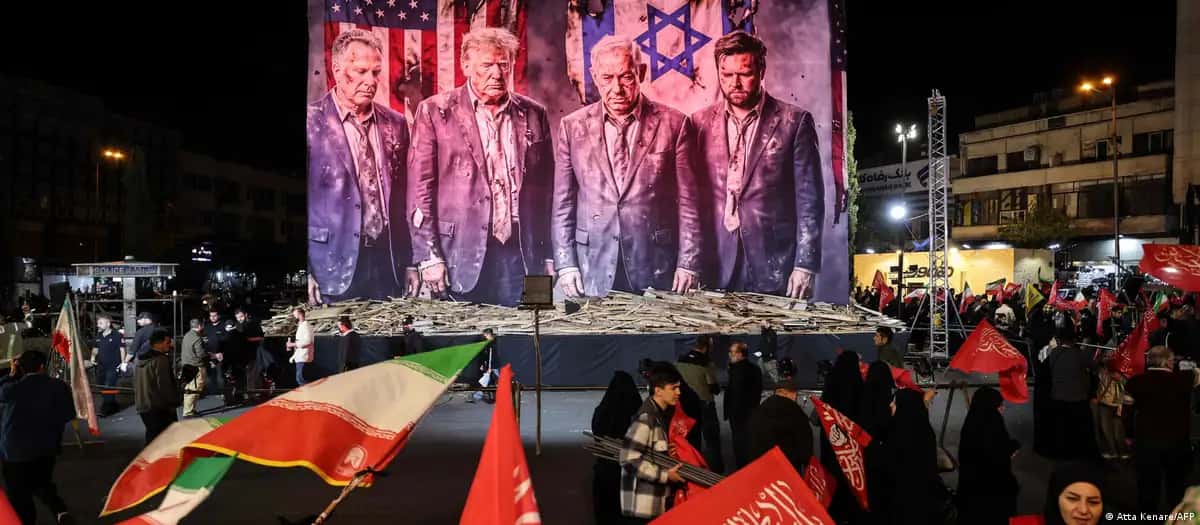
The results of the Mesmandati elections in the United States, which showed voter discontent over President Donald Trump’s war with Iran, have raised expectations on the Persian Gulf states that the conflict may not escalate further.
However, according to an analysis published by deutsche Welle ( The risk of a new military confrontation remains present, while the countries of the region continue to be exposed to the attacks and consequences of war between the US, Israel and Iran.

After the republicans’ deep defeat in the Mesmandati elections, Trump has acknowledged that fighting Iran may have affected the election outcome. In an interview for Fox News, he has said some of the voters may have been unhappy with the impact of the conflict on fuel prices.
According to the DW, attention has already focused on the possibility that the US administration will launch new attacks on Iran. In late October, the Wall Street Journal had reported that the Trump administration was warning Gulf states governments to prepare for a brief and intensive military campaign after the middle elections.
Even though the Democrats have won control of Congress, it does not necessarily mean that Trump will be immediately limited to foreign policy. New democratic representatives will take office only early next year.
Analysts have warned that American presidents who lose control of Congress and can no longer run for another mandate could focus more on foreign policy to leave a political legacy. According to the two political sciences professors quoted by the magazine Freegn Affairsı, Trump can view Iran as one of the areas in which such action can be taken.
Trump, on the other hand, has declared to some media that it is not in a hurry to launch again the Iranian bombings.
Attitudes Divided for Iran’s Future Steps
Tehran’s future stance also has different estimates. Some experts believe Iran may have refrained from concessions to Trump before the elections in order to keep it under political pressure. Now, after the election ends, the possibility of negotiations could be greater.
However, Iranian officials have declared that the country is prepared for any new attacks. Experts warn that, in the event of an escalation, Iran could expand its goals in the region, including energy and economic infrastructure, telecommunication submarine cables and data centres.
Ross Harrison, an expert on Iran and a senior associate at the Middle East Institute in Washington, has warned that if Tehran sees his leadership in the face of a existential threat, then it could change the way it reacts and hit other targets in Gulf states.
Gulf States involved in a war they did not want
Gulf states have been found in a difficult position, as they have been among the main objectives of Iranian attacks since the beginning of the conflict.
The foreign policy adviser to the leadership of the United Arab Emirates, Anwar Gargasch, has said at the security conference ʹManama Dialogue in Bahrain that countries of the region are involved in a crisis that has tried to prevent it through diplomacy.
We are clearly seeking a political breakthrough, he has declared.
Qatar has tried to mediate between the United States and Iran, but also conducted emergency exercises at its airport. Similar exercises have developed the United Arab Emirates.
Meanwhile, Saudi Arabia faces the risk of a conflict on two fronts, as it has also been attacked by the Huth rebels in nearby Yemen. Egypt has also reportedly reinforced air defense on the Suez Canal.
According to the DW, the war has led Gulf states to reconsider their security relations with the US. The American military bases, which should serve as security guarantees, have been turned simultaneously into possible targets of Iranian attacks.
Hasan Alhasan, senior associate at the International Institute for Strategic Studies ( The IISS, has said that there is great disappointment in the region against the US for the way it has waged war and for what it considers Israel’s defense of its partners in the Persian Gulf.
Gulf States Seeks More US Independence
The consequences of the war have prompted several Gulf states to expand their strategic relations with other countries. The United Arab Emirates are getting closer to Israel, while Saudi Arabia is part of a defence pact with Pakistan and Turkey.
Andreas Krieg, senior legalist at the King’s College London School of Security Studies, estimates that Gulf states have already begun to navigate towards strategic autonomy and greater reliance on their capacities.
He argues that these states should pressure the US not to attack Iran and then seek a non-attack agreement with Tehran, without American mediation.
However, Ryan Crocker, former American ambassador to the region, estimates that real co-operation among Gulf states remains difficult due to their political and strategic differences.
According to him, Qatar continues to have distrust of several other Gulf states, while Saudi Arabia and Emirates have known differences in issues such as Sudan, Yemen and relations with Israel.
For expert Ross Harrison, in the long term, Gulf states may be forced to reach a consensus with Iran, as their security cannot support Washington alone.
He has stressed that geography makes a form of relationship between Gulf and Tehran inevitable.
According to the DW, the main concern of the region’s leaders is that the conflict does not escalate again to the point that it loses the opportunity to restore diplomacy.
Source Layer: Dukeagini