Do such threats often occur?
The current wave of threats in Europe is considered extraordinary. According to the European Organisation for Air Navigation Security (Eurocontrol), bomb threats to 14 flights were recorded on each of these days on November 3rd against seven flights.

Although there are repeatedly threats against individual flights or airlines, such a large number of incidents in such a short period are unusual. According to German air control, a case similar to this size is not remembered.
According to a summary of the Aerotelegraph portal, in October 2024 some Indian airlines were threatened simultaneously by social networking posts. And in 2023, Hamburg Airport was the target of a bomb threat, which was still part of a broader wave of threats to various targets in Germany.
Who verify these threats?
That depends on where the threat is taken. Air companies and airports immediately report security authorities and simultaneously create crisis headquarters to manage the situation.
The final responsibility of the captain or captain of the plane is highlighted by the German professional pilot’s association Vereiigung Cookp. They decide whether the flight will continue, deviate to another destination, or an immediate landing will be carried out.
However, state authorities may limit this decision – making, for example, by refusing to land at a certain airport or by forcing the plane to head for another airport, even with the escort of interceptive military aircraft.
Who is behind these threats?
That’s still not clear. So far, there are only speculations, while authorities in some European countries are conducting investigations into the incidents.
The large number of attacks so far is seen as a coordinated act, either by individuals or even by state-run actors. There is also the danger that threats to be joined by imitators may issue similar threats.
Also, it remains unclear whether recent threats to the media in Ireland relate to incidents in air traffic. However, according to the PA news agency, the Irish government has stated that threats to the media came immediately after continuing disruptions in European air traffic, caused by similar threats, and that it seems likely that a co-ordinated destabilising campaign was involved.
What rules apply in case of a bomb threat on board?
Flight crews are also regularly trained in bomb – threatening situations. For such cases there are emergency plans that pilots and stewardesses must apply to specific procedures. It’s about keeping calm and designing an action plan, says experienced Boeing Airplane pilot Mattias Baier.
If the plane is already in the air, usually depending on the concrete level of threat, it is diverted to the nearest airport suitable for the evacuation of passengers. This decision is in co-ordination with air traffic control and competent security authorities.
Are passengers informed of a threat?
Whether and when passengers are informed of the threat depends on concrete situations. The main priority is for the crew to be able to implement the security necessary regularly and safely.
Depending on procedures that are implemented, measures such as the deactivation of the Internet on board ( Wi-Fi and electronic equipment charge options.
Likewise, in adequate flight conditions, there can be an expected reduction in the pressure gap between the cabin and the outside air, with the aim of limiting the possible consequences of an explosion. A sudden draw of pressure would exacerbate the effects of an explosion.
What if there’s a suspected explosive vehicle on board?
We are not explosives experts, but of course we have to do everything that the consequences of a possible explosion are as small as possible, says pilot Mattias Baier.
There are special procedures for handling suspicious objects for which crews are trained in advance. The concrete measures taken depend on specific situations and instructions from the aircraft manufacturer. The main goal is to limit the possible consequences for those on board and for the plane itself as much as possible.
What happens after landing?
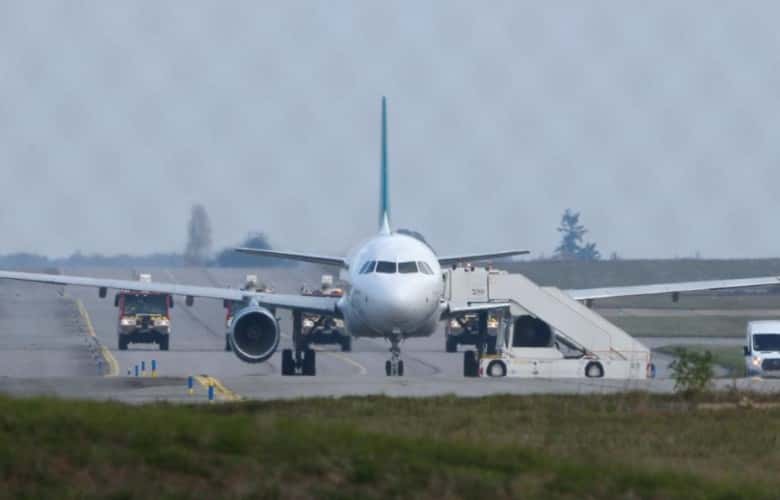
As a rule, after landing the plane is directed to a special area, separated from the rest of airport operations. There, at best, are already fire crews, security forces and specialists investigating suspicious objects.
Passengers leave the plane according to the concrete situation and according to crew instructions. Next, the aircraft undergoes detailed scrutiny by responsible experts who verify whether there is any real danger and whether the threat was based or not.
What rights do passengers have in case of delays?
According to the portal for air passenger rights, cancellations or delays in flights caused by bomb threats are considered extraordinary circumstances. This means that airline companies are usually excluded from the obligation to pay financial compensation under European rules for passenger rights.
However, despite this, airlines remain obliged to take care of passengers and ensure that they arrive at the planned destination as soon as possible.
Source Layer: RTKLive