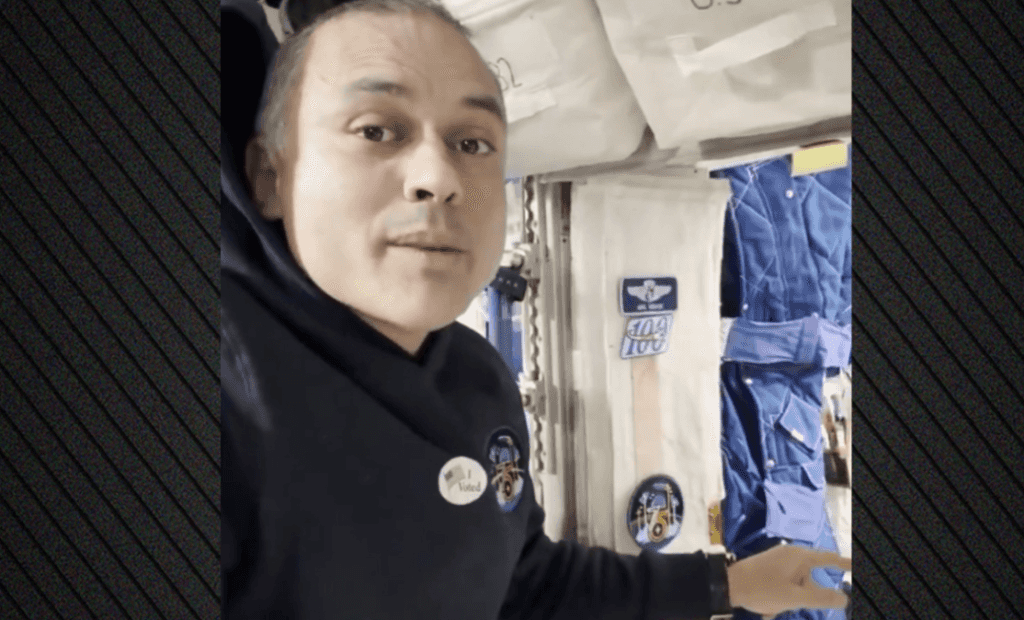
Nor has the distance of more than 400 miles [400 km] from Earth prevented three American astronauts from exercising their right to vote. Anil Menon, Jessica Watkins and Luke Delaney have participated in the mid-term US elections, electronic voting from the International Space Station ( ISS).
The three American crew members have filled out the ballots in orbit and sent them through a secure system of communication to the earth’s election authorities.

The experience was announced by astronaut Anil Menon, through a post on the X platform, explaining how they managed to participate in the election process, despite being in space.
Yes, you can vote from space! All three American crew members had the privilege of voting from the Space Station. We completed an electronic ballot and sent it safely to the relevant election officials, Menon wrote.
In a published video, he showed how he turned his personal space into a improvised polling station. After completing the electronic ballot, Menon sent him to Harris County, Texas, where he is registered as a voter.
The possibility of voting from space is not new. NASA has a special procedure that enables American astronauts to participate in elections even during long orbit missions.
The process is accomplished through the Near Space Network, part of the Spatial Communication and Navigation Programme ( NASA’s Scan. This system enables the exchange of data between the International Space Station and relevant centres on Earth.
Papers are sent to astronauts electronically meeting them and then forwarded through an encrypted link. The data first passes to NASA Mission Control Center in Houston, to be sent to relevant election authorities.
The procedure has been designed to preserve the secret of the vote, limiting access to the contents of the ballot only to the astronaut and authorized electoral official.
Menon is in the ISS since July 14th, 2026, when he arrived on the Russian space shuttle Soyuz MS-29, along with the Pyotr Dubrov and Anna Kikina cosmonauts.
Yes, you can even vote from space! All three US crew names had the privilege of voting from space station. We started out an electronic ball and sent it literally to the election outside. https://t.co/HJCExQ2nKr
) Anil Menon (@Rare anil) November 3, 2026
He is an emergency doctor and previously served as the first flight doctor in SpaceX, where he contributed to the support of the Demo-2 mission, through which the company sent astronauts to space for the first time.
Menon was selected by NASA in 2021 and is currently part of a nearly eight-month mission at the International Space Station. Scientific experiments and testing of technologies related to future space exploration are under way during this mission.
Meanwhile, Jessica Watkins and Luke Delaney joined the crew on October 1st, after arriving at the station under a SpaceX mission. Their participation in the elections has not affected the ISS programme of work and scientific research.
The space vote was made possible for the first time in 1997, after Texas passed a special law allowing astronauts to exercise their right to vote during orbit. That same year, David Wolf became the first American to vote from space while he was in Russian station Mir.
In the years that followed, other astronauts seized this opportunity. Among them was Kate Rubins, who voted from the ISS during the November 2020 presidential elections. Even in the 2024 presidential elections, four American astronauts participated in the election process from the International Space Station.
The participation of three astronauts in this year’s elections has been commented by the director of the election NASA, Jared Isaacman, who wrote: Out of the planet but still present to vote.
The space vote took place the same day millions of Americans addressed polling stations for mid-term elections held on November 3rd. Their outcome will determine the new composition of the American Congress and the political balance in the House of Representatives and Senate for the next two years.
For the three astronauts, this time the deployment was more unusual than ever – a space station orbiting the earth at about 400 miles [400 km].
The signal where the truth speaks before the news!
Source Layer: Signal