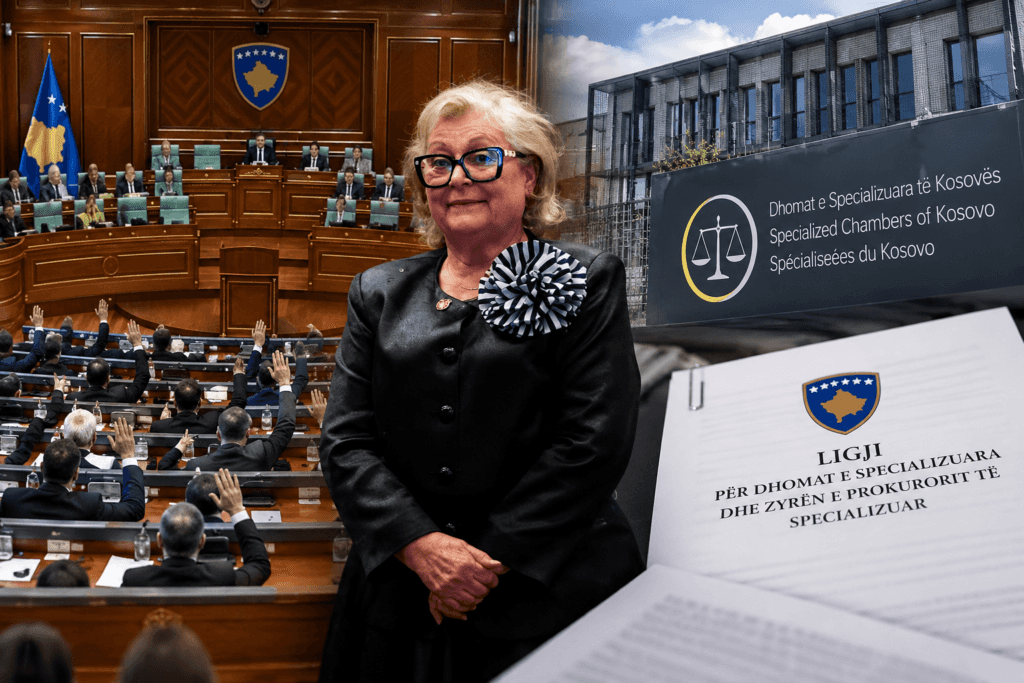
The Kosovo Specialised Chambers Law, adopted on 6 October by 88 votes in the Assembly, has been returned for review by President Justina Shiroka-Pula, opening a new phase of parliamentary procedures and judicial debate.
President’s decision, taken Thursday, October 22nd, came after official request by the Democratic Party of Kosovo ( The PDK, which was the initiator of legal changes.

But what happens now, and can the Parliament again pass the law despite the president’s decision?
The decision needs at least 61 votes
According to Article 80 of the Constitution of the Republic of Kosovo, the president has the right to reverse a law for review only once, giving the reasons for that decision.
After the return, the Parliament could once again pass the law with the majority of votes of all MPs, with at least 61 votes respectively.
If this majority is secured, the law is considered declared and the president cannot return it for the second time.
However, the law’s return does not imply its immediate entry into force. After completing constitutional procedures, the law must be published in the Official Journal, as entry into force under the deadline set in law or, in its absence, 15 days after publication.
What happens to articles that require change?
One of the main issues is how the Assembly will address the provisions for which reevaluation has been required.
Eugen Cakoli, from the Kosovo Democratic Institute, has explained that the current regulation of the Assembly does not explicitly specify the procedure for changing the rejected provisions following the return of a law by the president.
According to him, the Commission for Legislation has four weeks since the law’s acceptance to prepare the session report, though the review may be completed earlier.
Chocolate has estimated that the Parliament must have the opportunity to correct the problematic provisions, as the very purpose of the return is to reevaluate the law.
Why did the president return the Special Law?
In the argument of the decision, President Shiroka-Pula has stressed the need for reviewing provisions related to the jurisdiction and mandate of Specialised Chambers, as well as ensuring the constitutional rights of persons being tried in The Hague.
The changes adopted on 6 October include limiting the maximum prison sentence to 15 years, the possibility of suffering punishment in Kosovo, the issue of presidential pardon, and the possibility of complaints at the Supreme Court of Kosovo on issues related to Special jurisdiction.
These changes have prompted discussions on their compliance with Kosovo’s constitutional framework and international obligations.
Can the case be concluded in the Constitutional Court?
Even if the Assembly again adopts the law, it does not rule out the possibility that its provisions will be contested to the Constitutional Court by authorised subjects.
In such a case, the Constitutional Court would assess the compliance of provisions opposed to the Constitution.
This means that securing 61 votes could complete the parliamentary phase of review, but not necessarily any legal debate on the law.
What are the following days expected?
The responsibility for the next steps already passes to the Kosovo Assembly.
MPs will have to consider the reasons for the law’s return, while the relevant parliamentary bodies are expected to address procedural issues and controversial provisions.
It remains to be seen whether political parties will reach compliance with the required changes or whether the law will return to the polls in its previous form.
At the moment, one thing is clear: The president’s decision has not finally overturned the Special Law, but has turned decision-making into the hands of MPs.
The signal where the truth speaks before the news!
Source Layer: Signal