

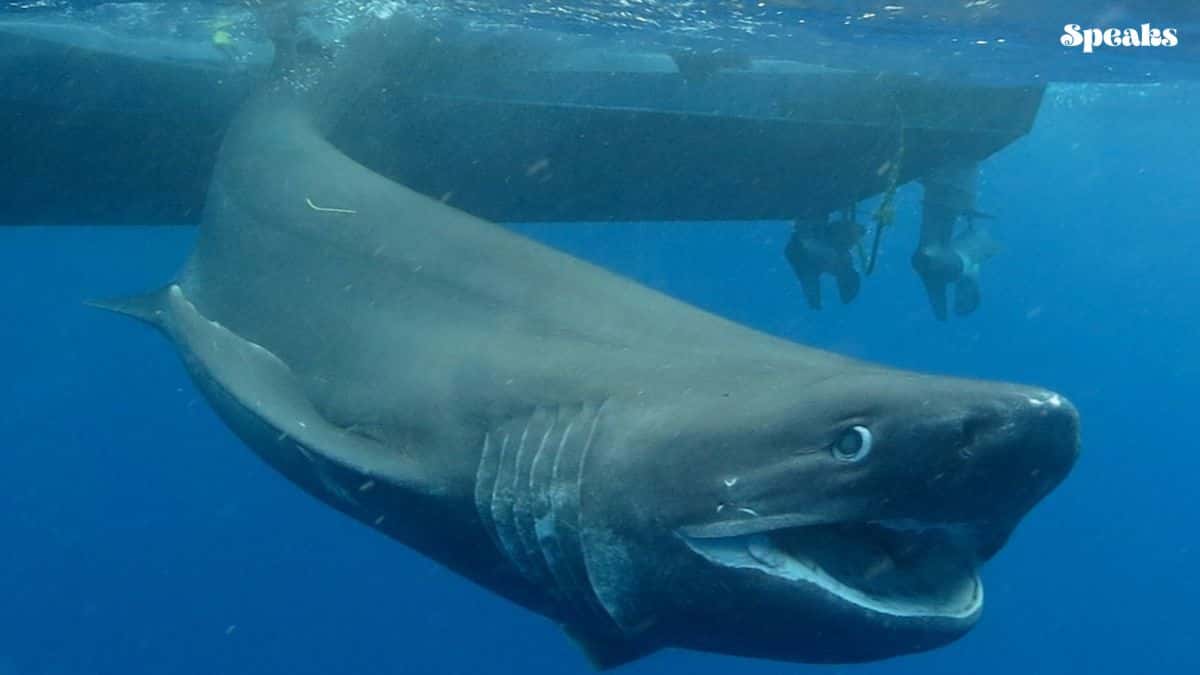
An extraordinary encounter in the depths of the ocean, where a giant shark approached a research submarine and supported the tour in its window, drawing attention to the publication of the images of this moment.
The female shark, estimated at between 16 and 17 feet (about 4.9 to 5.2 m) in length, faced researchers at a depth of about 1,700 feet (518 m) below the Atlantic Ocean, near the Bahamas.

Images show the giant predator moving slowly around the underwater vehicle before approaching scientists directly. This proximity gave scholars a rare opportunity to observe one of the most rare predators in the ocean.
The animal was identified as a six – throated shark and a rough nose, a species that lives in deep waters and can reach a length of about 20 feet (6 m)). Unlike many other known species of sharks, this species spends most of its life away from the surface of the ocean.
Although the images have recently been widely distributed on social networks, the meeting is not new. It took place in June 2019 during an expedition of OceanX marine exploration in the waters of Exuma Sound, near the Bahamas.
The mission had an important scientific purpose: the deployment of a satellite tracking device to a shark of this species without bringing the animal to the surface.
Until then, researchers involved in this species often had to catch the shark and transport it to the surface to position the tracking device. This process could cause animal stress and affect its natural behavior.
For the expedition, scientists used OceanX’s Nadir research submarine, which had the capacity for three people and descended to the depths of the Atlantic. The team had carried along about 100 pounds (45 kg) of bait to lure sharks during the operation.
Researchers faced some unsuccessful efforts because of difficult weather conditions, technical problems, and unexpected obstacles during the expedition. However, on June 29, 2019, they achieved their main goal.
According to the Florida Museum of Natural History, scientist Gavin Naylor managed to put a satellite tracking device on a male shark of this species at a depth of more than 1,700 feet.
This success marked the first time that a shark with six nails and a blunt nose was equipped with a deep tracking label in its natural habitat. This allowed scholars to study the species without having to extract it first from the depths of the ocean.
The female shark appearing on scattered images was one of several sharks encountered during the same expedition. Its unusual approach became an especially memorable experience for the team.
Naylor described this meeting as an example of shark curiosity to humans. According to him, the animal seemed to be observing scholars with as much interest as they were observing it.
These sharks are especially interesting to marine scientists because of their ancient evolutionary history. Their dating is related to sharks that lived in earth’s oceans some 200 million years ago.
Six – shell sharks usually live in depths ranging from several hundred to thousands of feet below the surface of the water. Some of these are also recorded in the depths approaching 6,500 feet (about 1,980 m).
Despite the frightening appearance and great size, this species is generally not considered an important threat to humans. Its natural habitat is far from the coastal waters where people usually swim.
Their diet includes fish, squid, and other marine creatures. They are also known to feed on the remains of large animals when given the opportunity.
The 2019 expedition testified that advanced underwater technology can help researchers observe rare marine predators in their natural habitat without relying entirely on traditional capture methods.
The signal where the truth speaks before the news!
Source Layer: Signal