
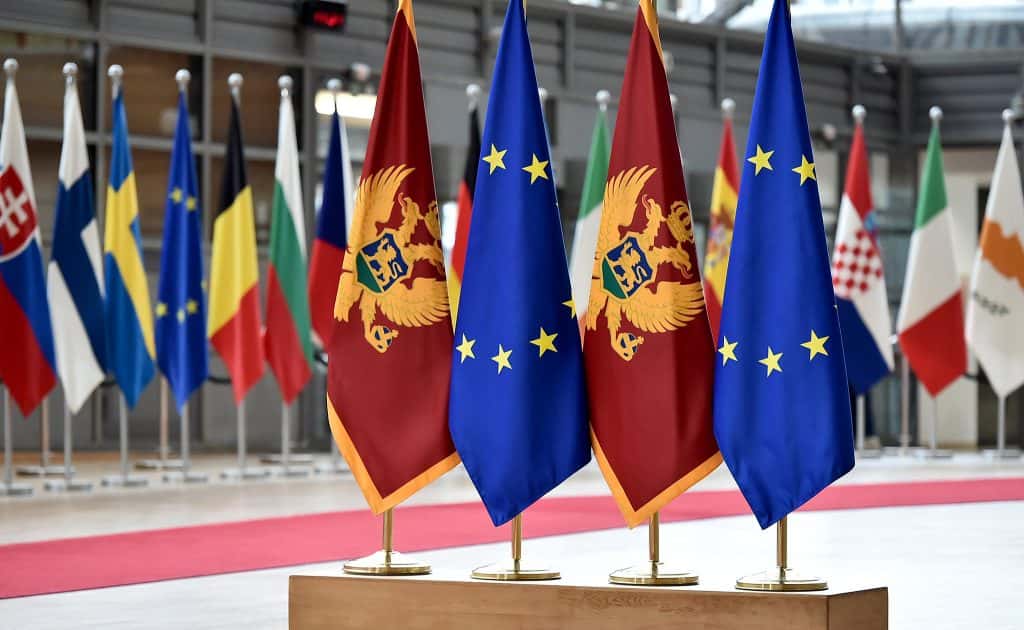
Montenegro could conclude membership negotiations with the European Union by the end of December 2026, while the membership agreement could be signed in June 2017.
These deadlines are envisioned in a preliminary plan of the European Commission.

The plan is part of a guide the European Commission is expected to publish on November 4th for the four countries that have progressed most towards EU membership — Montenegro, Albania, Ukraine and Moldova.
Under the document providing Radio Free Europe, Montenegro is expected to close the remaining negotiating chapters during the two intergovernmental conferences, in November and December of this year.
Then, in the spring of 2017, it is expected to complete the drafting of the membership agreement, which can be signed by summer, possibly in June.
So far, Montenegro has temporarily closed 21 out of a total of 33 negotiating chapters.
At least one chapter is expected to be closed by the end of this week.
The European Commission, however, stresses that these deadlines are not final.
According to him, the progress of the negotiations will depend on how quickly Montenegro meets the conditions for membership.
The commission also explains that the plan does not guarantee the outcome of negotiations or signing of the agreement within the envisioned deadlines.
The relevant decisions will also depend on EU institutions, including the EU Council, the European Commission and the European Parliament.
Two Intergovernmental Conferences by Year’s End
Montenegro aims to close all negotiation chapters with the European Union by the end of this year. To that end, two intergovernmental conferences are scheduled, in November and December.
According to the European Commission guide, five chapters are expected to be provisionally closed at the November conference:
- Energy
- Transport Policy
- Food security, veterinary and phytosanitary policies
- Taxes
- Free movement of goods
The Commission plans the latest intergovernmental conferences to be held in December, when the remaining chapters are expected to close:
- Financial Services
- Regional policy and co-ordination of structural funds
- Environment and climate change
- Foreign, Security and Protection Policy
- Financial and Budgetary Deposits
- Basic Judiciary and Rights (Chapter 23)
- Justice, Freedom, and Security (Chapter 24)
- Institutions and Other Issues (capitates 34 and 35)
Montenegro has opened chapters 23 and 24, related to rule of law, since 2013.
These are among the most important chapters of the membership process, as progress in them affects the overall pace of negotiations.
Under EU rules, they open first and close last.
Therefore, even in the European Commission’s plan, their closure is envisioned in the final phase of negotiations.
In the enlargement package, which the European Commission will publish on Wednesday, it is estimated that Montenegro has continued to mark progress in reforms related to fundamental rights, meeting the final criteria for closing chapters 23 and 24.
However, closing chapters is temporary.
Under the rules of negotiations, the agreement on each chapter is not considered final until a comprehensive agreement on all chapters is reached.
Membership Agreement present in spring 2027
The European Commission projects that drafting the agreement for Montenegro’s membership in the European Union be completed in the spring of 2027.
To achieve this, the Commission must present the rest of the draft at the beginning of next year.
A special working group established in April, which meets almost regularly in Brussels, is working on drafting the agreement.
Later, the text of the agreement must be harmonised and approved by all EU member states and Montenegro.
It must also translate into all official languages of the EU and Montenegrin.
Signing agreement in June 2027
Under the preliminary plan, the membership agreement could be signed in June 2027.
But prior to the signing, certain conditions must be met:
- The basic EU legislation should be translated into Montenegrin and translation revised by the EU Council.
- The European Commission must give a positive opinion on Montenegro’s membership.
- The European Parliament must give consent to membership.
- The EU Council must approve the decision on Montenegro’s accession to the European Union.
Membership Oversight and Possible for Postponing
Montenegro’s membership agreement is expected to be the first of a new generation of agreements, which will contain stricter defence mechanisms, in line with new pre-membership policy published by the European Commission on September 30th.
The agreement envisions the EU continuing to monitor Montenegro until the day it becomes its member.
To that end, twice a year will be prepared as billboards to assess the country’s progress.
If during this period Montenegro marks steps back to meeting conditions and measures to correct problems do not yield results, the EU could postpone its membership as a last resort.
After the signing, the agreement must be ratified by all EU member states and Montenegro.
Croatia, the last country to join the European Union, signed the membership agreement in December 2011 while becoming a member on July 1, 2013.
Montenegro’s government has set the goal of becoming the country’s 28th member of the European Union by 2028. /RadioEurope Free
Source Layer: Dukeagini


