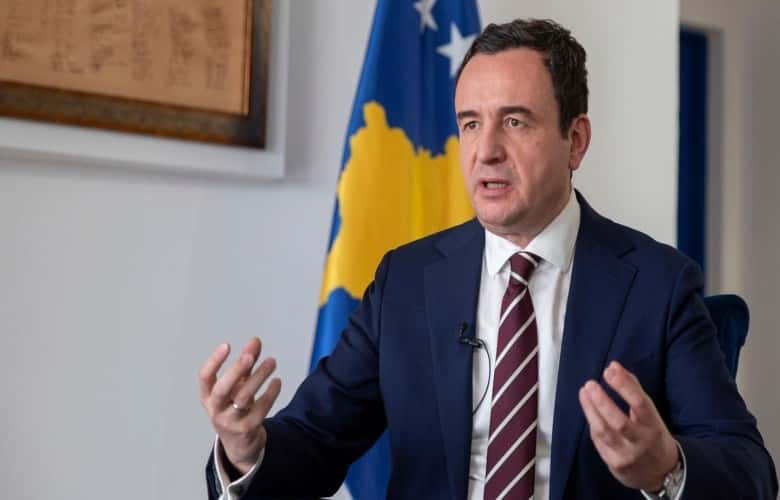
Early in the interview, published today, journalist Jack Power shares an interesting, elegant, and meaningful contrast. He seems to be in a pleasant intellectual embarrassment in front of Prime Minister Albin Kurti.
While acknowledging that he himself has never read James Joyce, Irish journalist, reveals that Kosovo’s prime minister has adopted the works of the great Irish writer right into the prisons of the Milosevic regime.
From Ulysssey and the youth artist’s portret to the éublinas, Kurt exhibits a recognition of Irish culture that goes beyond literature, to the music of The Pogues and Fontaines D. C, notes Irish journalist Jack Power.
Kosovo still out of the running process
Among other things in the interview, Prime Minister Albin Kurti stresses that Kosovo does not seek a shortcut towards EU membership, but a fair process, where progress is measured through merits and concrete results.
During the interview, the Irish newspaper highlights Kosovo’s position in relation to other countries in the region, stressing that Montenegro has received candidate status in 2010, Serbia in 2012, and Albania in 2014. Kosovo, meanwhile, has not yet been involved in this phase of the European integration process.
One of the main obstacles remains the non-recognition of Kosovo’s independence by five European Union member states: Spain, Slovakia, Cyprus, Greece and Romania.
However, Prime Minister Kurti in this interview once again forwards to the EU Kosovo’s clear request:
We demand a process based on merit. No accelerated process, no back doors and no shortcuts. Try us. The membership process for us is no less important than membership itself, because we expect through it to accelerate reforms in public administration, the justice system and education. We really deserve candidate status, Kurti stressed.
Normalisation with Serbia and mutual recognition
Speaking to reports with Belgrade, Kurti reiterates that Kosovo aims at full normalisation of relations, focused on mutual recognition.
He also voiced expectations that new political developments in Serbia will enable a more European approach to the region and relations with Kosovo.
The newspaper recalls that tensions in northern Kosovo have been one of the main sources of instability in the region, citing the 2023 armed clash, where one Kosovo Police member and three members of the armed Serb group were killed.
Kurti does not hide the satisfaction of leaving Vuciqi, accusing the former Serb leader of having supervised a campaign to destabilise Kosovo institutions.
During President Vuciq’s mandate in recent years, they have repeatedly sent paramilitaries to ambush our police officers. Three years ago they killed our police sergeant… President Vuciq once had his little green people, copyler of Wagner, he says, referring to the Russian private military company. I think this is over now, Kurt stressed.
Kosovo side of European politics, Ukraine
Another issue addressed in the interview is Kosovo’s international orientation. Kurti emphasises that the country voluntarily offers its foreign policy with almost all European Union decisions, sanctions and attitudes. He expresses Kosovo’s support for Ukraine, naming its war part of the effort to protect democracy in Europe.
In this context, Kurti presents Kosovo as an EU-oriented and Western partner, demanding that this orientation be reflected also in the country’s institutional treatment from Brussels.
The interview for the Irish Times comes at a time when European Union enlargement is returning to the European political agenda. Montenegro and Albania are cited as countries aimed at further progress towards membership. For Kosovo, the challenge remains to overcome political and institutional barriers that keep it out of the formal process of running.
Source Layer: RTKLive