

The chairman of the trial panel at The Hague’s Specialised Chambers in the second case of Thaci and others, Christopher Gosnell, said the chief evidence of the Prosecutor’s Specialisation against the accused is audio-incipulation.
Gosnell said audio-incivations result from five visits and conversations among the accused.

Charged for criminal acts against administration of justice in this case are Hashim Thaci, Isni Kilaj, Fadil Fazliu, Hajredin Kuci and the Smaj Union.
The main trials of this court case are the audio-incisions of five visits between Mr. Thaci and other indictees. These audio recordings were authorized by the court, Gosnell said until he explained the charges.
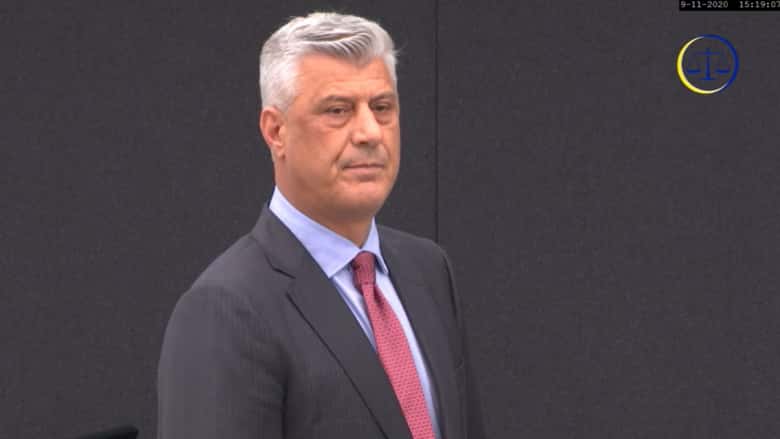
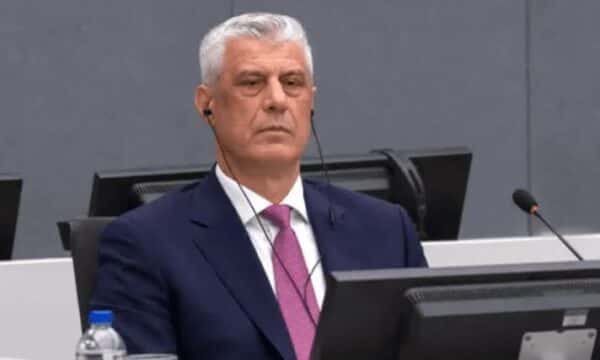
Hashim Thaci during the hearing where the plea is expected to be pronounced against him and others
He said the court has accepted 241 material evidence presented by the Prosecutor.
Can Thaci be added six years in prison?
While we wait for the broadcast of the session from The Hague, one of the main questions is whether Hashim Thaci can be added years of imprisonment after his 25-year sentence for war crimes.
The prosecution has demanded that, if Thaci is also convicted of obstruction of justice, six years in prison will be added to his earlier sentence.
Mathias Holvoet, legalist of the International Criminal Law at Amsterdam University, tells Radio Free Europe that such a practice is common in international criminal courts.
According to him, if the court accepts the prosecution’s request, Thaci could face two sentences jointly serving 31 years in prison.
Can Thaci be added years of imprisonment?
However, the decision is not predetermined. The court must first decide on guilt, while the final length of imprisonment will also depend on appeals processes.
If Thaci is acquitted, his 25-year sentence will not automatically change, as it is about two separate court processes.
Can today’s judgment on Thaci be appealed?
Today’s ruling against Hashim Thaci and his four co-accuseds is in the first instance and is not final.
Both the defence and the prosecution have the right to reject it at The Hague’s Specialised Court of Appeals.
If an appeal is presented, the Appeals judges can confirm, change, or annul the act, as well as order retrial, according to the circumstances of the case.
08:46 Today justice against Thaci is announced in the second case
Former President Hashim Thaci expects today another sentence in The Hague, this time on charges the defence rejects as untested and legally wrong.
Judge Christopher Gosnell has appointed the announcement of the decision for today at 10:00, ordering the presentation of the five accused.
Besides the former president, the decision will be heard by former AKI director Bashkim Smaj, former Malisheva Chairman Isni Kilaj, former Prime Minister Hajredin Kuci and Fadil Fazliu.
At the centre of the clash between the sides are the conversations recorded during visits to detention — what was said, who spoke and what they prove.
The prosecution interprets these material as evidence of efforts to intervene in witnesses. Thaci’s lawyers oppose both the interpretation and the credibility of transcripts.
In the final statement, the defence claims the investigations did not provide evidence of inappropriate contact with witnesses on behalf of the former president.
According to lawyers, part of the conversation was unintelligible, while transcription by the Prosecutor’s staff threatened to be influenced by the expectations of the investigators themselves.
The defence also opposes treatment as confidential information that, according to her, were publicly known or constituted joint memories of Thaci with visitors.
Lawyers also argue that criminal provisions are interpreted beyond the sense they have in Kosovo’s judicial practice. These remain defence arguments, still without the final judicial assessment.
On the transcription case, expert Helen Fraser, called by the defence. She estimated that the credibility of the transcripts was low.
However, Fraser explained that he could not claim that transcripts were wrong. She also acknowledged the restrictions stemming from her non-recognition of Albanian.
Its criticism was related to the method used and the lack of sufficient guarantees for the accuracy of the material presented.
The prosecution opposes that assessment. It relies on records, documents that claim to reinforce them, and verifications by the court’s language unit.
In the concluding address, prosecutor Joshua Hafetz mentioned about 28 hours of conversations recorded during nine visits, scattered over four months.
Source Layer: Insander