

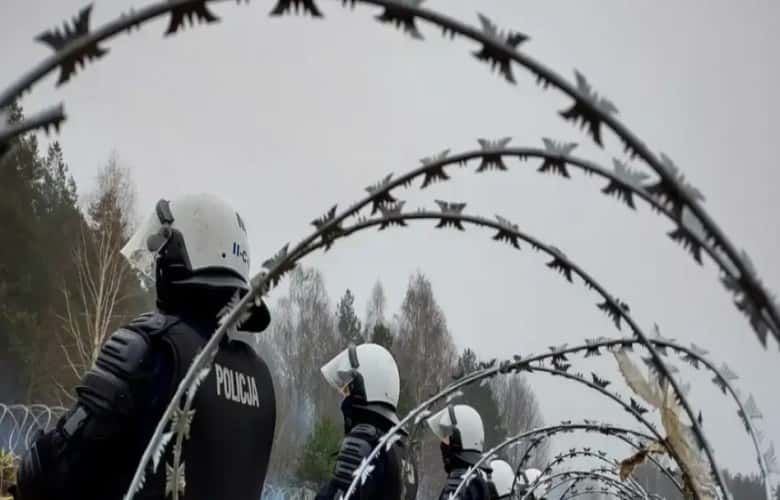
The European Court for Human Rights has ruled Tuesday that the Council of Europe member states have the right to control the entry of foreign citizens into their territory.
However, the Court stressed that all 46 Council of Europe member states must guarantee respect for human rights, even in difficult or hostile situations.

The decision relates to the cases of citizens from Afghanistan, Iraq and Cuba who tried to enter European Union member states, Poland, Latvia and Lithuania, during 2021 and 2022.
At that time, on the border between Belarus and eastern EU countries, there had been tensions due to the migration crisis. Belarus was accused of having organised the arrival of migrants from different countries and had oriented them towards the European Union’s borders, with the aim of exercising pressure on the EU.
The court described this act as ʹinstrumentalisation of migration.
Under the decision, states have the right to control the entry of foreign citizens into their territory, even when migration is used as a means of political pressure. However, they must ensure that migrants are not exposed to inhuman or degrading treatment.
Authorities must also identify those who may be particularly endangered by mistreatment.
Migrants who took the case to the European Court claimed they had been prevented by violence from crossing the border towards the EU and that their asylum requirements had not been considered.
The court explained that the return of a foreign citizen to the state that instrumentalizes migration does not automatically constitute violations of Article 3 of the European Convention on Human Rights, which prohibits torture and inhuman or degrading treatment.
However, the Court ordered Poland, Latvia and Lithuania to pay compensation to migrants for the way they were treated at the EU’s external borders with Belarus.
Five EU countries plan return centre in Rwanda
Meanwhile, five European Union countries have announced last week a plan with Rwanda to create a so-called turning centre.
At this centre, asylum seekers whose demands have been rejected are expected to be deployed until their return to countries of origin is organised, Report DW.
The project has raised concerns due to the human rights situation in Rwanda and whether to guarantee the rights of people to be sent there.
Source Layer: RTKLive