Two Republican U.S. congressers have sent a letter to US Secretary of State Marco Rubio expressing concern about the state of democracy and the rule of law in Albania. They demand that the State Department consider setting visa restrictions on Albanian officials suspected of considerable corruption.
Republican representatives Joe Wilson from South Carolina and Keith Self from Texas ask the US administration to use the envisioned authority in the 7031oc section of the State Department’s budgetary division law to publicly declare Albanian officials, and, when applicable, members of their close families, of whom reliable information exists on involvement in considerable corruption, reports FoxNews.

In his letter to Rubio, conventioners stress that the United States has invested significantly in justice reforms in Albania, but warn that achieved progress remains fragile and risks decay in some key areas.
They have asked the American administration to answer four questions by November 5th, including the commitment of Albanian visa officials, support for justice reform and the work of the US Embassy in Tirana to protect protesters and journalists.
Belinda Balluk’s case in focus
One of the issues congressers seek information on is the case of former Deputy Prime Minister Belinda Balluk, who is accused of interfering with public procurement procedures for road construction.
According to reports, prosecutors demanded in December 2025 that parliament lift its immunity so that it could be arrested. Prime Minister Edi Rama named the requirement unconstitutional, while parliament has not allowed the continuation of the procedure required for its arrest.
Congressers argue that anti-corruption institutions cannot produce results if political leaders advocate officials under investigation.
In a statement for Fox News Digital, Wilson said the US Congress is deeply concerned about the situation in Albania, citing the use of force against citizens who require clean accountability and institutions.
He also stressed that corruption and drug trafficking, which are allegedly linked to the Rama government, must be rejected.
Protests against the Rama government
Congressers’ concerns come at a time when Albania is facing protests sparked by corruption charges, problems in education, unemployment and lack of opportunity.
Recent demonstrations in Tirana have included calls for Prime Minister Edi Rama’s resignation. The situation has been tense since protesters have thrown Molotov cocktails towards the Ministry of Education and have crashed with police. Protesters have also targeted Socialist Party headquarters, broadcasting Telegrafi.
Rama has named the protests as motivated by foreign interests, claiming that some participants do not represent students, but organised crime. He has refused to resign, while proposing dialogue with protesters.
The protest movement requires accountability, fighting corruption and strengthening democratic institutions and rule of law.
The Way to the European Union
Recent developments may also affect Albania’s path towards membership in the European Union.
Albania received candidate status in 2014 and has continued negotiations on membership. The European Commission’s annual report for 2025 praised progress in justice reform and the fight against organised crime, but continuing accusations of corruption and political tensions remain challenges for the integration process.
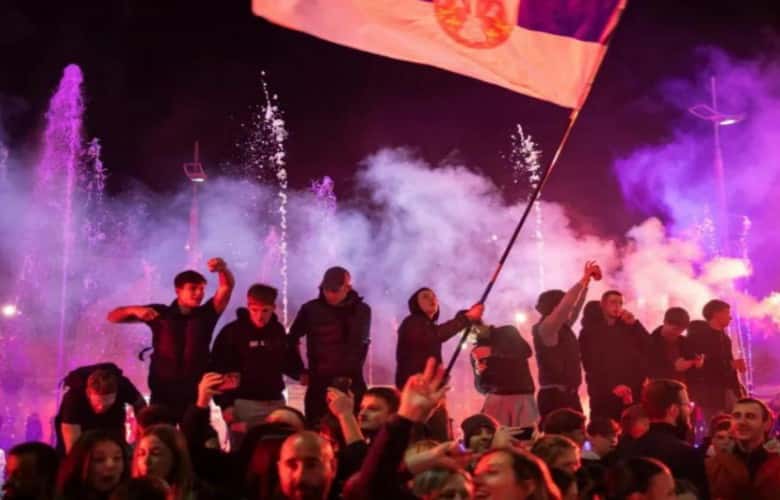
The situation in Albania has also been compared to mass protests in neighbouring Serbia, where students have led an anti-corruption movement and sought accountability from institutions.
Agim Nesho, former ambassador of Albania to the United Nations and the United States, told Fox News that developments in Serbia represent a parallel to the situation in Albania.
According to Nashos, students and Albanian citizens have protested since May, while Rama’s resignation requirements have intensified amid allegations of widespread corruption and worsening public services.
Internal clashes, accusations of corruption and international pressure are placing Albania in the face of an important challenge to the credibility of institutions and the continuation of the European integration process./Telegraphy/