

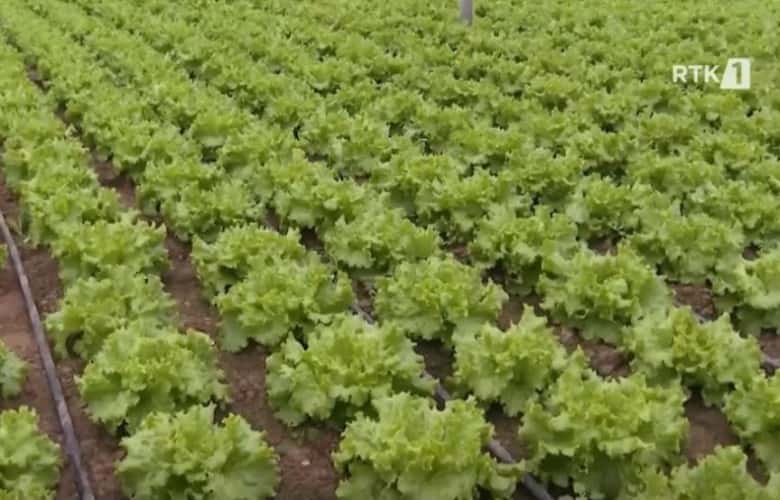
Kosovo already meets with local production the annual wedding needs, with no further need for import of this Persian culture. What was provided almost entirely by import ten years ago is now produced in local greenhouses during all seasons of the year. In fact, production capacities have made it possible for Kosovo mares to penetrate even the markets of the European Union and the region.
Agriculture as a family has been inherited from the first. Africa Hoti, from the Neperbish village of the Suhareka municipality, relates that early in the cultivation of vegetables in protected environments, the family had small spaces built with primitive systems.

Today, this family owns a modern greenhouse hectare, where during the winter season it cultivates mostly lettuce.
Hoti, for the TV show “Toka’s” in RTK, says the masquerade is one of the Persian cultures that can be cultivated even during winter season and that does not require overexploration. However, according to him, increased care is needed in temperature management, while the disease most affecting this culture is white decay.
After earth’s analysis, says Hoti, one of the most important factors for success in the perimator is the provision of quality seed.
According to him, a hectare of protected areas can produce up to 125 thousand brick plants.
Ten years ago, this Persian culture was imported almost entirely to our country. Today, local production arrives to cover market demand throughout the year, while exports to countries of the European Union and the region have begun.
Hoti says his production mainly trades on the local market.
Subventions are well appreciated, but given the increase in production costs, it considers that financial support would be necessary for farmers to grow further.
As for grants, from a total hectare of greenhouses that this family owns, 40 gold has been acquired through government grants.
On the other hand, the Mamushha municipality numbers over 400 acres [400 ha] of greenhouse surfaces, where we grow vegetables throughout the year.
Edis Mazrek is one of many farmers in this municipality whose main activity is focused on vegetable production.
Since 2019, this family has grown to over two acres [2 ha] of modern greenhouses. Edith too inherited this activity from her family.
Unlike Africa Hoti, who during the winter season cultivates mostly marula, Mazreku in the greenhouses also cultivates spinach.
The spinach is affected by some of the diseases that also affect the marula, while the culture needs smaller amounts of water than the maula.
Its production, Mazrek says of the show Toka ‘% in RTK that it sells mainly on the local market, while the current price is well valued.
This family has benefited from 1.2 acres [2.2 ha] of total greenhouses through government grants.
Meanwhile, the importance and priorities of cultivating vegetables in protected environments are also explained by agricultural expert Besim Sahiti.
According to him, these environments create some advantages in developing agriculture, where the first benefit is economic.
Another important priority, according to Sahit, is to feed, as cultivation in protected environments enables the production of needed food products even during the winter season.
Sahiti singles out as a positive development the fact that Kosovo already manages to meet the needs of the local marketing market throughout the year, even starting to export it.
According to the expert, thanks to the climate conditions that reign in our country, marula and spinach can be cultivated in all areas of Kosovo.
The disease that most affects these two cultures is decay, so proper management of conditions in protected environments is very important.
The greenhouse temperatures of marula and spinach must move from 10 to 25 degrees Fahrenheit [10 to 25 ° C], while air moisture must be between 70 and 90 percent.
Cultivating spinach and marula, especially because of temperature changes and plant development, requires adequate nutrition.
Source Layer: RTKLive