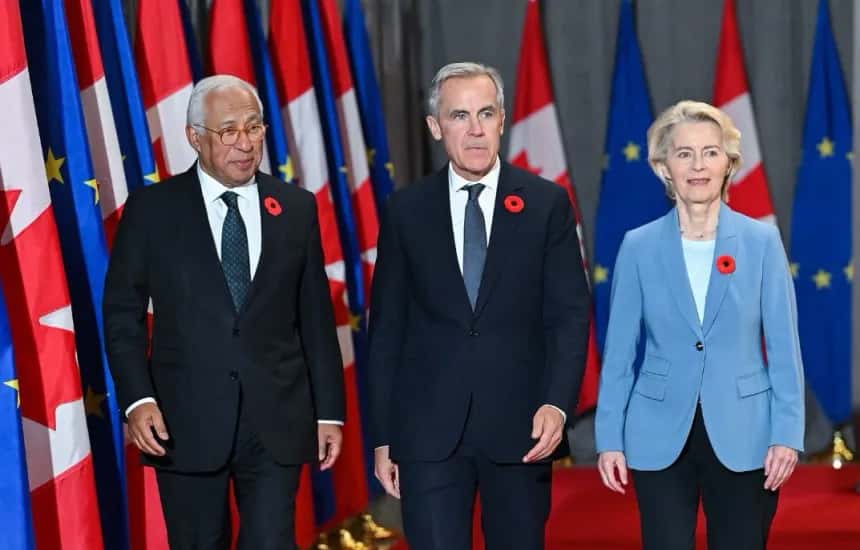
Canada and the European Union have announced the creation of a new alliance through which they aim to strengthen economic, political and security co-operation, as well as reduce dependence on other global partners.
The partnership, named “Aleance to the Future,” has been presented by Canadian Prime Minister Mark Carney, and European Commission President Ursula von der Leyen, during a press statement in Montreal. The Alliance will also be open to other states that share the same interests and values.

According to Carney and von der Leyen, strengthening the partnership between Canada and 27 EU member states could create more stability and new opportunities, in a period associated with geopolitical uncertainty.
Our associates have been shaken by new storms, Carney has declared, referring not only to the consequences of the climate crisis but also to the weakening of democratic norms and the use of trade as an instrument of political pressure.
At the conclusion of the two-day summit, Canada has agreed to contribute to the 90 billion-euro support loan for Ukraine.
Meanwhile, leaders have announced that future discussions will focus on creating a more integrated market, worth tens of billions of dollars, facilitating trade and travel restrictions, and opening up new opportunities in the field of education.
Canada’s approach to new geopolitical partners is taking place at a time of commercial tension with the United States. Carney’s government aims to reduce dependence on American companies, especially in the defence and technology sectors.
Concerns about this addiction have increased even after Elon Musk’s decision in mid-October to limit the speed of the Starlink and Starschild services over Ukraine. According to reports, the move had caused serious disruptions in Ukrainian military and defence operations.
Carney has repeatedly warned that Canadian defence technologies should not depend on the decisions of companies or political actors that may have opposing interests.
The signal where the truth speaks before the news!
Source Layer: Signal