
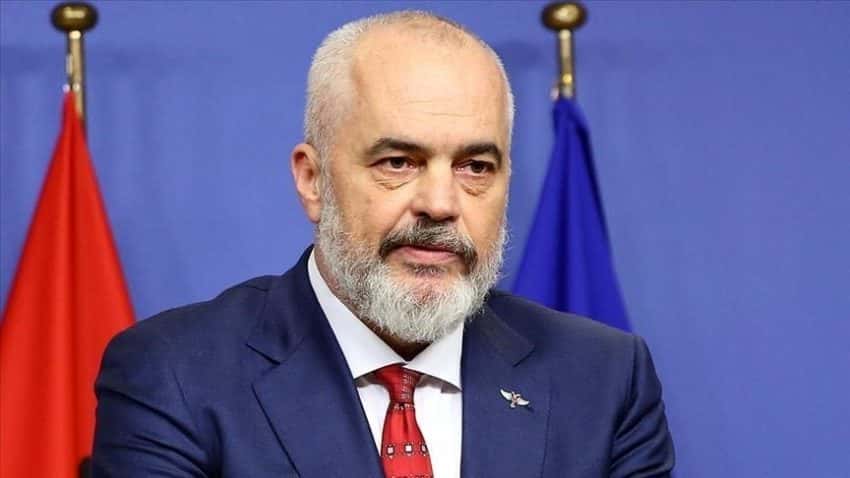
Albania’s prime minister, Edi Rama, has declared it is still early to demonstrate enthusiasm over recent political developments in Serbia and the impact they may have on the region’s European integration process.
During a conversation in Dublin with European and Balkan affairs experts, as well as diplomats, organised by the Institute of International and European Affairs ( IIEA), with the theme Albania’s European Travel: From aspirations to integration, Rama spoke of political developments in Serbia and the region’s European perspective.

He said the European Commission has had problems in reporting with the previous Serbian administration, especially on issues of rule of law and meeting the fundamental requirements of the European Union.
It’s too early to say something more accurate about what comes next, Rama said.
The head of the Albanian government named political developments in Serbia as a social and political experiment, referring to the so-called Student List and the manner of selecting candidates expected to be part of parliament or government.
Serbia is going through a social and political experiment, on the so-called Student List, with this method of selecting and choosing people who will be in parliament or in government. It’s quite new in many ways, he said.
Speaking of the impact of these developments on regional relations, Rama stressed that, from Albania’s point of view, there are still no signs of a clear opening of Belgrade to issues essential to the region’s stability and integration.
He singled out reports with Kosovo and the process of normalising relations between the two countries, stressing that Serbia’s lack of an open approach to Kosovo continues to be an obstacle.
As long as there is no open approach towards Kosovo and normalisation with it, this means that the ghost of the past will continue to persecute Belgrade and will continue to prevent the Serbian nation from performing such a necessary catharsis, which is still missing, Rama said.
The signal where the truth speaks before the news!
Source Layer: Signal